
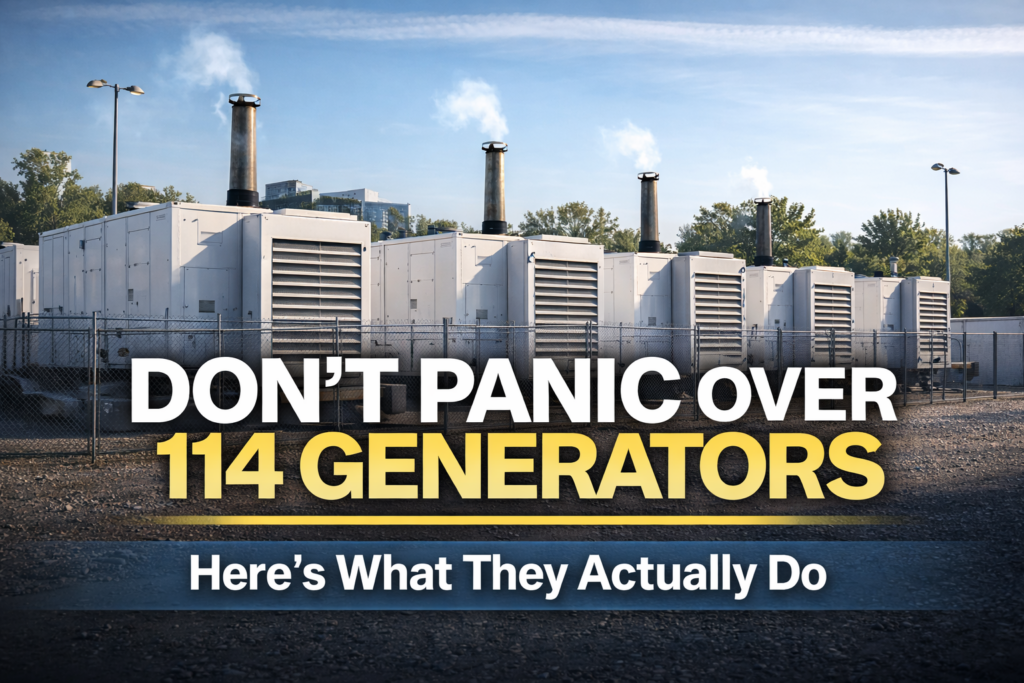
LIMA, Ohio — A proposed data center near N. Cole Rd. and W. Bluelick Rd. has drawn sharp reactions online after residents noticed a draft air permit referencing 114 diesel-fired emergency generators. The language has prompted fears about constant exhaust and round-the-clock pollution.
The record shows something more ordinary: these are backup units meant to protect critical services when grid power fails. The permit is draft, not final, and the Ohio EPA is gathering input before any decision.
What is being proposed?
- The application covers emergency-only generators sized and numbered to keep the facility online during a power outage.
- Under standard practice, these engines are idle nearly all the time, starting automatically during outages and for short, scheduled test runs.
- As with any air permit, regulators model conservative “what-if” scenarios to set limits and conditions. That modeling does not mean the units will operate continuously in everyday life.
How often would they run?
Emergency generators typically operate:
- During grid outages (unplanned and infrequent), and
- For brief maintenance/testing, commonly conducted on a set schedule (for example, monthly checks measured in minutes, not days).
Even adding up those tests across all units, annual run time is a tiny fraction of total hours in a year.
“Will we be breathing this in?”
Online comments often picture a constant plume at ground level. That’s not how these systems work.
- Location & dispersion: Exhaust is released above ground and disperses into open air. Concentrations drop rapidly with distance.
- Scale: A short test window or a rare outage event is not comparable to standing next to a tailpipe.
- Air is mostly oxygen and nitrogen: Local air remains overwhelmingly oxygen (~21%) and nitrogen (~78%). Pollutants, when present, are measured in parts per million or billion and are regulated to stay below health-based thresholds.
This doesn’t minimize that diesel exhaust contains pollutants; it clarifies the exposure reality for nearby neighborhoods.
Context: Lima already manages larger, continuous sources
Residents naturally compare this proposal to the Lima refinery, a facility with continuous, process-related emissions that has faced federal scrutiny and added major controls. By contrast, backup engines are intermittent and limited-use by design. The two profiles shouldn’t be conflated.
Are that many generators unusual?
Not for data centers. Modern facilities build redundancy to meet reliability standards (the same principle hospitals, 911 systems, telecom hubs, banks, and airports use). Large campuses often install dozens to hundreds of backup units so any single engine carries only part of the load.
It’s also worth noting the irony: the social platforms where these concerns are being shared—like Facebook—operate from data centers that rely on diesel backup fleets today.
The transition to cleaner backup is real (and ongoing)
While diesel remains the current industry default for emergency power (fast-start, high energy density, proven reliability), the sector is moving:
- Battery energy storage is beginning to replace or supplement diesel in some locations.
- Hydrogen fuel cells have been successfully demoed at multi-megawatt scale.
- As the grid mix gets cleaner and storage improves, future projects are likely to need fewer hours on diesel—or different backup tech altogether.
Change is happening, but it arrives in phases; high-availability sites cannot gamble on unproven backup during a blackout.
What’s next for the Lima proposal?
- The air permit is still in draft form. Ohio EPA will review public comments and can adjust conditions before final action.
- Residents who want a say can submit factual, specific comments (for example, about test scheduling, noise abatement, stack height, or monitoring/reporting conditions). The agency’s docket lists how to file.
Quick “Myth vs. Fact”
Myth: “These generators will run all day and choke the neighborhood.”
Fact: They’re emergency-only with short testing windows. Continuous operation would defeat their purpose and violate typical conditions.
Myth: “This is like having a refinery in my backyard.”
Fact: A refinery emits from ongoing industrial processes. Backup generators run intermittently and are regulated under different assumptions.
Myth: “Any amount of diesel means the air won’t be breathable.”
Fact: Air remains overwhelmingly oxygen and nitrogen. Permits require modeling to ensure ambient limits are protected, even during testing.
Bottom line
- The headline number—114 diesel engines—sounds dramatic until you understand why they’re there and how they operate.
- For modern data centers, emergency diesel fleets are standard practice today, even as cleaner backup options expand.
- Compared with the region’s continuous industrial sources, the intermittent emissions from emergency-only operation represent a different, smaller risk profile.
- The permit is not final; constructive public comments can shape test schedules, reporting, and safeguards.